
A new book by Kenneth Saxskiold-Nørup
What if leadership were not about controlbut about learning to interact?
CURRENT is a practice for leaders navigating organisations, decisions and themselves under conditions that keep moving.
It is a way of reading movement, remaining present under pressure and shaping direction without pretending to control the system.
Start here
Which of these is closest to where you are standing?
Choose the situation you arrive with. You will get a short orientation — two questions to sit with, the concept the chapter turns on, and the thinking behind it — before deciding where to read on.
CURRENT Companion
Put a question to the thinking itself.
Read and explore the thinking behind CURRENT: ask it a question and it usually returns one. Take a reading path, or read in depth for the argument, the objections, and the threads to pull next.
CURRENT Companion is for the book and the thinking. If you are working with a real leadership situation, Leadership Companion → begins from the situation instead.
Explore a reading path
Thematic routes through the material, not the Second Edition chapter sequence. Each opens as a reading thread you can question.
Also inside CURRENT
The thinking as it is still being written.
Beyond the book, the Companion and Study — all three offered above — CURRENT carries the writing that continues between them. Where the thinking is put to work in real leadership situations, it is practised through SAXSKIOLD.
About the book
A practice for leading in motion.
CURRENT reframes leadership not as a position of control, but as a cultivated capacity to remain present, oriented, and purposeful while everything is already moving. Drawing on Heraclitean philosophy, complexity theory, and decades of Nordic executive advisory, the book argues that the essential challenge is not strategy or structure — it is learning to interact — to read movement and shape conditions rather than impose outcomes.
At its core is a simple, demanding framework:
Three capabilities for grounding the self, reading what is emerging, and acting with intention rather than force. A book for leaders, coaches, and thinkers willing to engage with the complexity of real organisational life — not as a problem to solve, but as a current to navigate.
The premise
Organisations, and the people within them, are never static. Like a river, they are always already in motion. The question is not how to stop the flow — it is how to navigate it with skill, awareness, and integrity.
Certainty and control are limited; conditions keep moving whether or not a plan accounts for them. What CURRENT asks the reader to consider is a practice rather than a promise of control.
The model
The flow through self.
Conditions arrive from upstream, pass through a person, and leave as the conditions everyone downstream has to work in. That model describes the terrain — the practice below is what a leadership team does about it.
A three-part capability
Stay · Sense · Shape.
A framework for grounding the self, reading emerging conditions, and acting with conscious intention rather than reactive force. It is repeated rather than completed: each pass changes the conditions the next one begins in.
The vocabulary behind the practice →
Stay
Ground the self.
Cultivate the inner stability from which any clear act of leadership becomes possible. Presence before posture.
Sense
Read the emerging.
Attend to what is forming in the field — patterns, tensions, signals — before they harden into events demanding reaction.
Shape
Act with intention.
Move with the current, not against it. Shape conditions; do not impose outcomes. Conscious intention over reactive force.
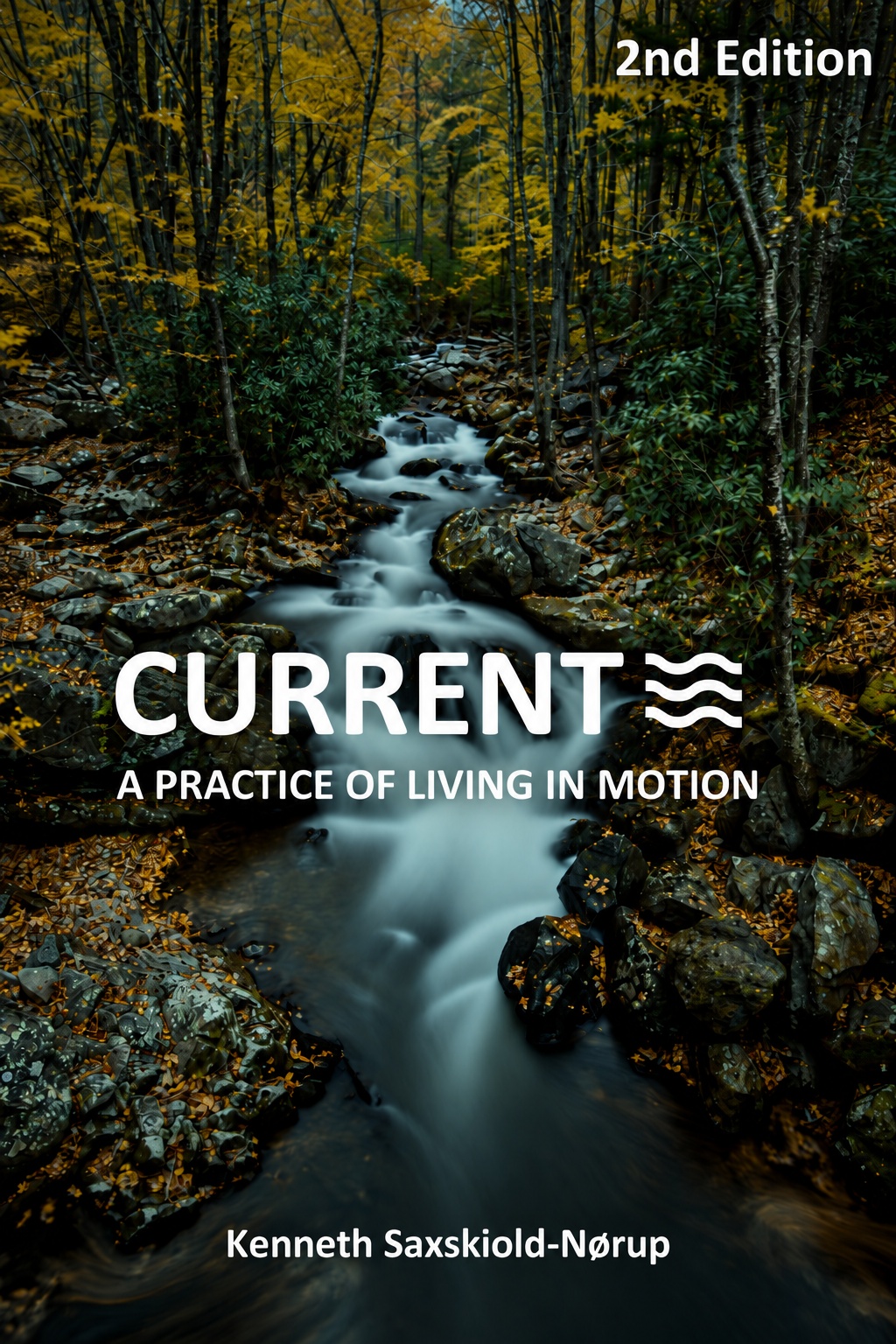
CURRENT — Audiobook
A Practice of Living in Motion — Second Edition
Narrated in English by Madison — digital voice edition
Listen to CURRENT in clear US English, chapter by chapter.
Listen to a free preview
To the Reader
The opening of the audiobook: an introduction to CURRENT as a practice of living in motion — and a suggestion of where you might enter the stream.
Lost your listening link?

The author
Kenneth Saxskiold-Nørup.
Executive advisor, writer, and practitioner. For more than two decades Kenneth has worked alongside Nordic and international leaders navigating complexity, succession, and transformation — translating philosophical depth into the lived realities of organisational life.
About Kenneth Saxskiold-Nørup →CURRENT in practice
The thinking has a working life outside the book.
CURRENT is also used in leadership, relational and organisational work through SAXSKIOLD — where the thinking meets real situations, decisions and change.
Explore CURRENT in practice →